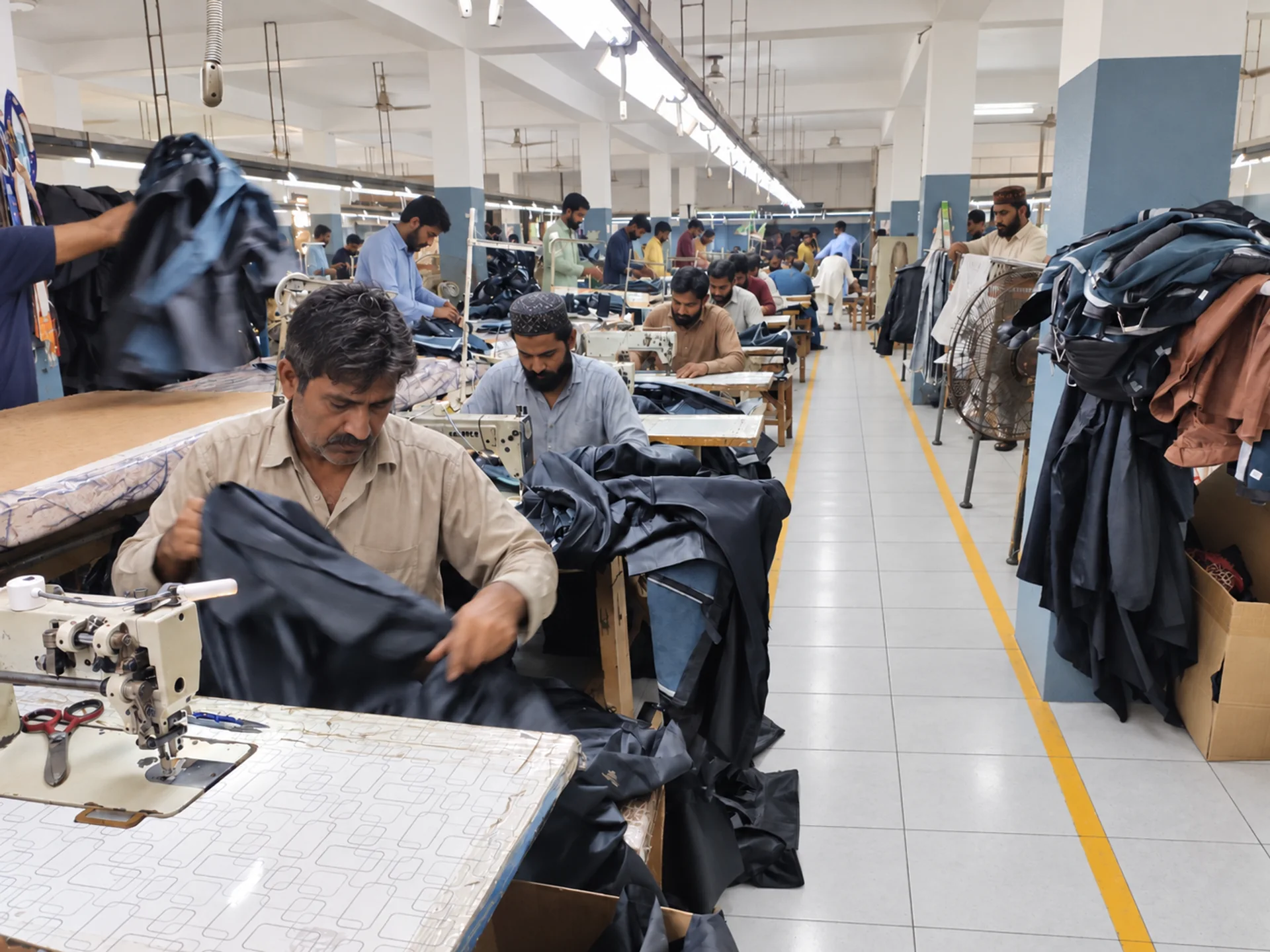
Women’s leather jackets with faux-fur collars, cuffs and linings offer several directions for a private-label winter collection. A cropped jacket, belted silhouette or hooded style can share a material palette while serving different fit and merchandising needs. The development brief must describe both the appearance and the construction behind it.
This guide explains how to specify a sheep-leather shell, choose synthetic fur, compare five design concepts and prepare a sample for approval before bulk production.
Understand the material combination
In this collection, sheep leather refers to the genuine leather outer shell, while faux fur refers to the synthetic pile used for trim and body lining. Smooth sleeve lining is specified separately. Faux fur does not make the whole garment vegan: the shell remains animal-derived leather.
Do not use “shearling” as a substitute for faux fur in your product brief. Specify each component clearly so the supplier, sample team and buyer are working toward the same material combination. Avoid describing a lining as polyester, acrylic or another fibre until its composition is confirmed.
Ask for approved swatches of the leather, faux fur and sleeve lining. Record their supplier references and retain a signed reference set with the final sample. A photograph alone cannot establish thickness, handle, backing or pile density.
Specify the sheep-leather shell
Start with the silhouette and intended fit. A compact cropped design and a relaxed bomber need different pattern allowances, even when both use sheep nappa leather.
Your material brief should identify:
- Leather type, finish and approved colour reference.
- Target thickness and acceptable tolerance, agreed with the sample maker.
- Required handle and drape, assessed using a physical swatch.
- Acceptable natural markings and panel-to-panel shade variation.
- Panel layout, seam placement and reinforcement requirements.
Review these choices on a complete sample. A swatch that looks suitable in isolation may behave differently once combined with fur, lining, seams and hardware. Use the same intended underlayers when assessing the fit of successive samples.
Choose faux fur for each location
Treat the collar, cuffs and body lining as separate specification decisions. They can share a colour without necessarily requiring identical pile lengths or backing.
| Component | What to define | What to check on the sample |
|---|---|---|
| Collar or hood edging | Pile length, fullness, colour and attachment method | Face clearance, balanced shape and freedom from zipper interference |
| Cuffs | Finished depth, circumference and fixed or removable construction | Wrist movement, symmetry and compatibility with gloves or knitwear |
| Body lining | Fibre composition, pile density, backing and coverage | Internal room, seam bulk and lining tension during movement |
| Sleeve lining | Composition, finish and attachment | Ease of putting the jacket on over the intended underlayer |
Agree how the fur will be secured at edges and seams. If detachable trim is required, specify the fasteners and their locations; do not assume it is included in a standard design. Review the fastening method on the sample before approving it for production.
Five designs for a women’s winter range
The following Hashbloom designs use genuine sheep-leather shells with synthetic faux-fur details. Their catalog images are AI-generated development visualizations; final construction and measurements require physical sample approval.
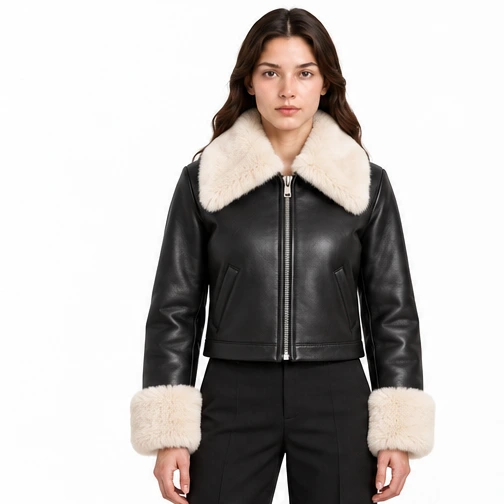
1. Black cropped jacket with ivory faux fur
The black cropped faux-fur sheep-leather jacket combines a short body, contrasting collar and cuffs, a centre zipper and welt pockets. For development, focus on the finished hem position, collar balance and comfort when the arms move forward.
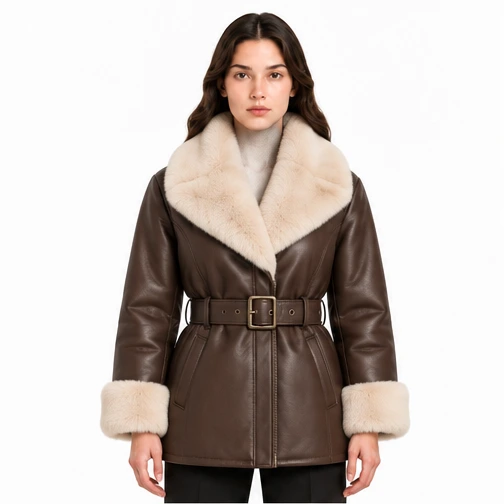
2. Chocolate belted jacket with cream faux fur
The chocolate belted jacket uses an extended silhouette and a matching leather belt. Confirm belt length, buckle dimensions, loop placement and pocket access across the size range. Check the garment both belted and unbelted.
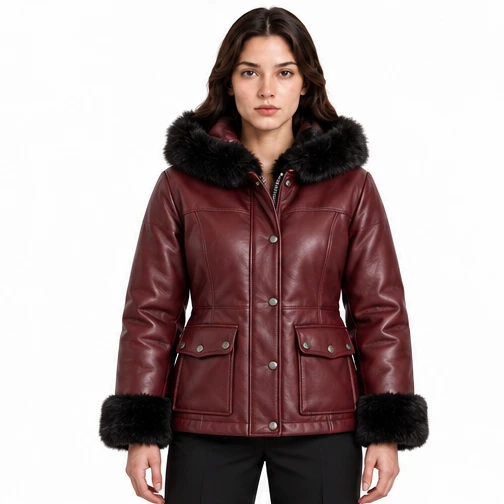
3. Burgundy hooded jacket with black faux fur
The burgundy hooded jacket combines a fur-edged hood, snap placket and lower flap pockets. Assess hood depth, visibility, neck comfort and zipper operation. Check that the trim stays clear of the closure.
4. Ivory wrap jacket with taupe faux fur
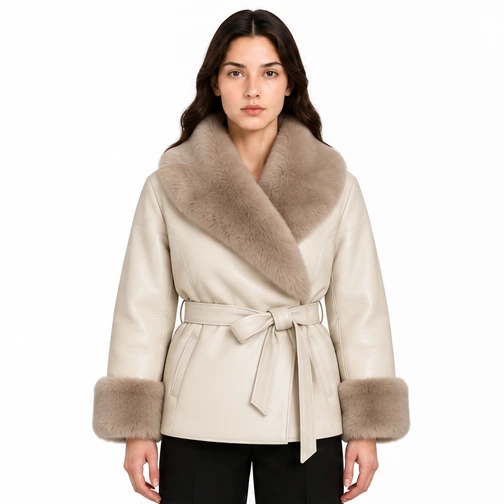
The ivory wrap jacket pairs an overlapping front with a self-tie belt and contrasting shawl collar. Agree the overlap at each size, concealed closure positions and belt placement. Review colour consistency across the light leather panels.
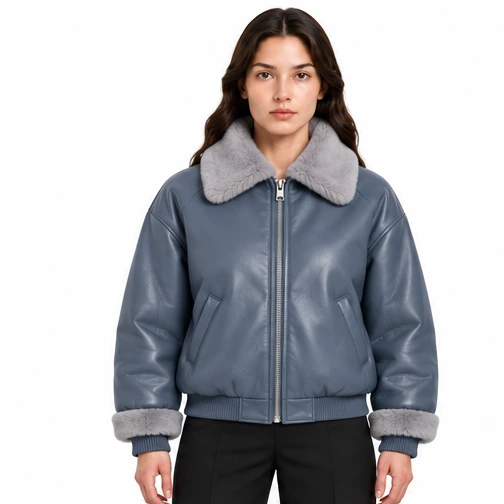
5. Slate-blue bomber with silver-grey faux fur
The slate-blue faux-fur bomber offers a relaxed body with tonal rib trim. Specify rib dimensions, colour and recovery requirements, then check the waist and cuff fit alongside the internal lining allowance.
Build a clear OEM development brief
Send front and back references, construction details, target measurements and a list of intended changes. Identify which features are essential and which can be adjusted during sampling.
Include your size range, quantity by style and colour, destination, required delivery date and branding artwork. Specify label placement, logo method, hardware finish, hangtags and packaging. Obtain confirmation of any additional minimums or development costs for custom trims.
Separate body measurements from finished garment measurements. State where each measurement is taken and define tolerances with the factory. The proposed XS–3XL charts in this collection are development starting points, not measurements verified from completed production samples.
For a more detailed document structure, use our leather jacket tech-pack guide.
Approve the sample before bulk production
Record sample comments in one revision document so the pattern maker and production team receive the same instructions.
- Confirm materials: compare the shell, fur, lining and hardware against the approved references.
- Check fit: assess closure, sitting, reaching and movement over the intended underlayer.
- Inspect construction: examine seam appearance, trim attachment, pocket positions and lining tension.
- Review fur behaviour: check visible shedding and pile trapping during handling and closure operation. Agree formal test methods and acceptance criteria where required.
- Check branding: approve label wording, logo placement, colour and packaging artwork.
- Approve the final standard: sign off the revised sample, measurement chart, materials and construction notes together.
Do not infer a temperature rating or waterproof performance from the appearance of a lined jacket. Any performance claim needs evidence appropriate to the finished garment. Our sample approval checklist provides a broader review framework.
Plan quantities, timing and packing
These designs list a starting MOQ of 50 pieces per style. Confirm colour splits, size allocation and material availability in the quotation; custom trims may affect the order requirements.
Typical listed timing is 7–10 working days for sampling and 25–35 working days for bulk production, subject to materials and the confirmed schedule. Ask when each period begins, and allow separately for revisions, approvals and shipping before committing to a launch date.
Agree packing that protects the leather surface and preserves the intended presentation of the fur. Review a packed sample and its appearance after unpacking. Care instructions should be established for the complete material combination rather than copied from a leather-only garment.
Frequently asked questions
Is faux-fur sheep leather the same as faux leather?
No. These designs specify a genuine sheep-leather shell and synthetic fur components. Faux leather would be a different shell material and must be quoted and described separately.
Can I change the fur colour or remove the hood?
Use the listed design as a starting point and include your changes in the brief. Material availability, pattern revisions, pricing and production suitability are confirmed during development.
Can I order under my own brand?
Private-label development can include approved labels, logo applications, sizing and packaging. Share artwork, placement references and quantities so the factory can quote the required work.
Are the listed images proof of finished samples?
No. They are AI-generated design visualizations. Request a physical development sample and dated sample photographs before approving bulk production.
Request a women’s faux-fur leather jacket sample
Choose a design and send your preferred colours, size range, quantity, destination and branding requirements. Hashbloom International can review your brief and confirm the materials, sample scope and quotation for production in Sialkot, Pakistan.