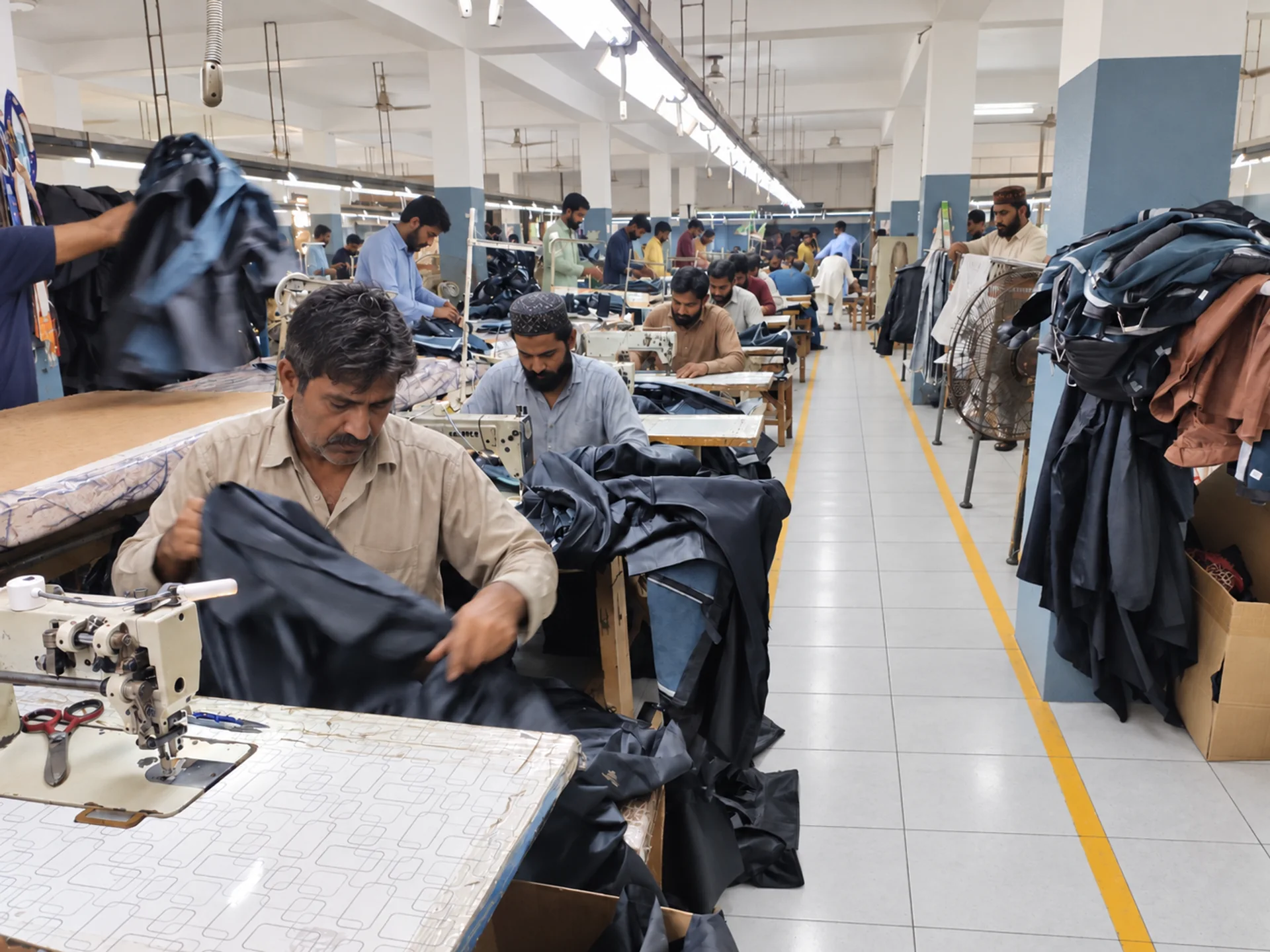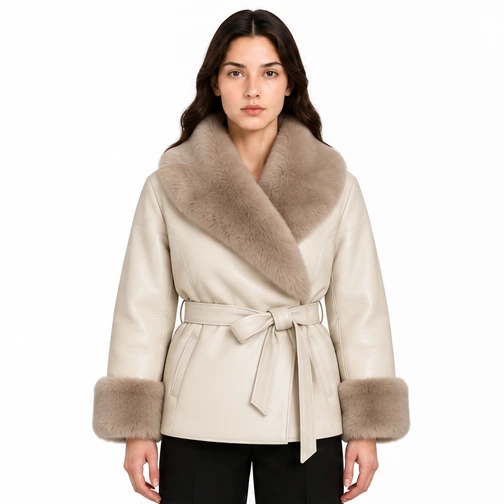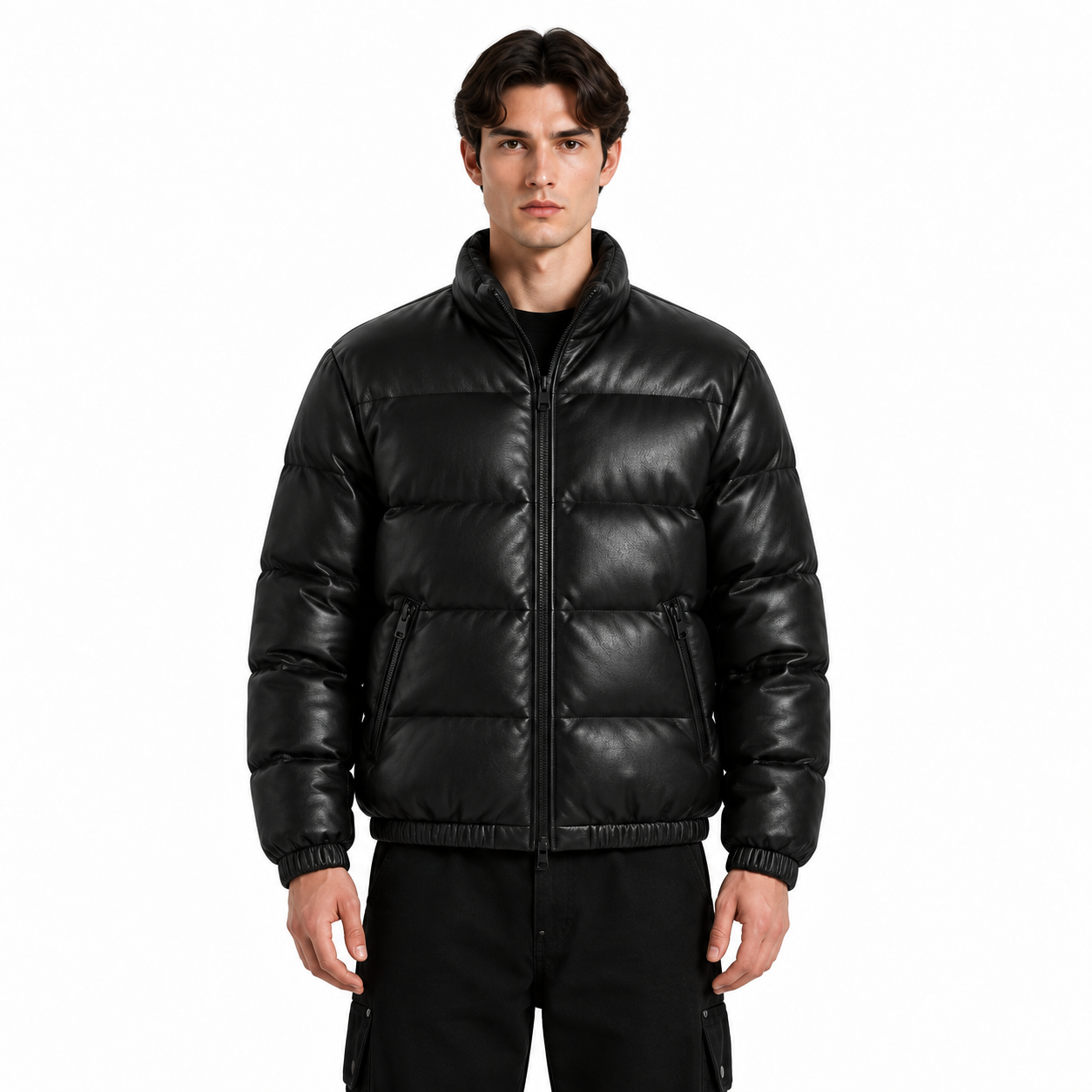
A men’s leather puffer collection needs a clear purpose for each design. A cropped jacket, a hooded cargo style and a longline silhouette can use a similar leather palette while answering different wardrobe needs. Choosing the right mix starts with your customer, intended layers and target retail positioning.
This guide compares five Hashbloom International design proposals and explains what to put in a private-label development brief. The product images are AI-generated visualizations, not photographs of finished samples. Materials, construction and fit require physical sample approval.
Start with the role of each jacket
Before choosing colours, decide how each style belongs in your range. Do you need a compact jacket to pair with high-rise trousers, a hooded design with visible storage details, or a longer silhouette worn over knitwear? Use your own customer feedback and sales history to decide which direction deserves the largest order.
Keep a shared element across the collection, such as a hardware finish, lining colour or label treatment. Then distinguish the styles through length, panel layout and pocket design. This gives buyers a coherent collection without making every jacket look identical.
Compare five men’s leather puffer styles
| Design | Collection direction | Key sample check |
|---|---|---|
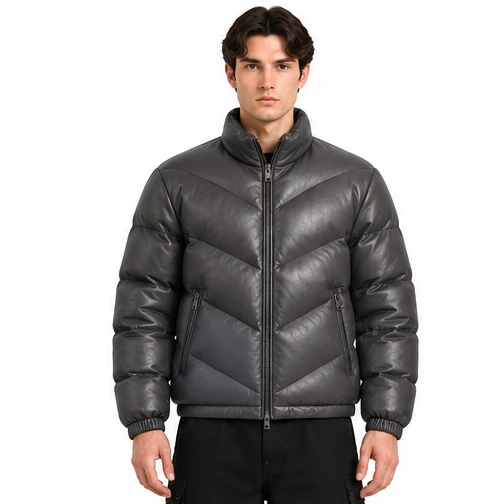
| Graphite chevron | A defined V-shaped panel pattern for contemporary outerwear | Quilting alignment across the front closure |
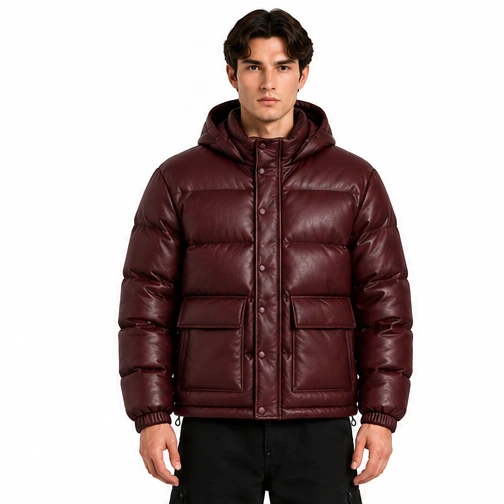
| Burgundy hooded cargo | A hooded silhouette with prominent utility details | Hood balance and pocket access when fastened |
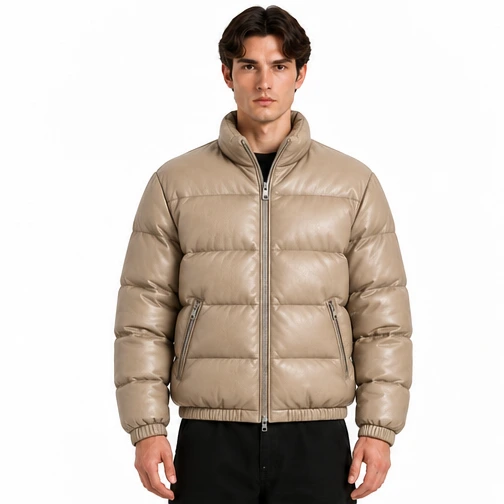
| Stone cropped | A shorter silhouette with a light colour palette | Hem position over the intended trousers and layers |
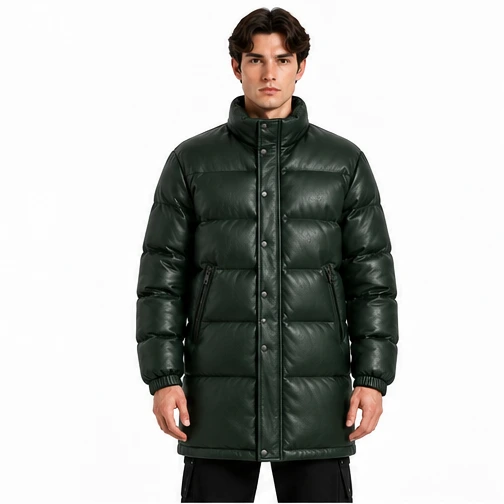
| Forest-green longline | A longer outerwear option for layered outfits | Sitting comfort and movement at the lower opening |
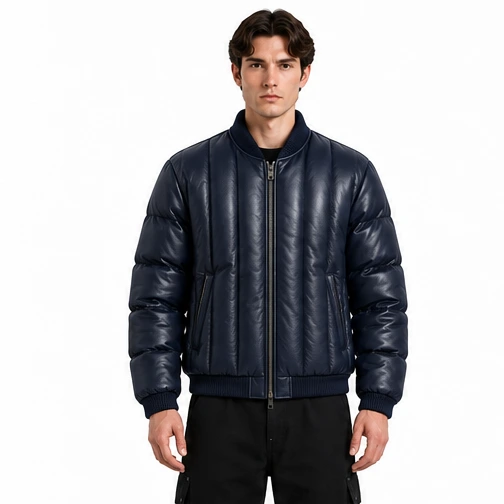
| Midnight-blue bomber | A compact bomber with channel quilting | Hem, cuff and sleeve proportions on the filled sample |
Graphite chevron: let the quilting define the design
The graphite chevron sheep-leather puffer jacket uses V-shaped padded panels, a stand collar and zipped hand pockets. It provides a distinct visual direction without relying on an oversized logo.
Mark the chevron angle and panel spacing in the tech pack. Review how the pattern meets across the zipper and how it changes through the size range. Approve the padded collar height with the jacket fastened, checking clearance around the chin.
Burgundy hooded cargo: plan the functional details
The burgundy hooded cargo puffer jacket offers a stronger utility direction. Treat the hood and pockets as fit and construction decisions, rather than decorative additions alone.
During sampling, check whether the wearer can reach the pockets comfortably over the intended underlayer. Review the hood both raised and lowered, and agree pocket dimensions, closure details and reinforcement. Added components should be included in the quotation and approved specification.
Stone cropped: define the finished length precisely
The stone cropped sheep-leather puffer jacket gives the collection a shorter shape and lighter colour option. Its proportions should be developed alongside the trousers and knitwear your customer is likely to wear.
Record back length and hem opening as finished garment measurements. Check arm raising and sitting, then review the jacket from the side. Approve physical leather swatches and panel shade matching; a screen image cannot serve as the final stone colour reference.
Forest-green longline: check movement through the body
The forest-green longline puffer jacket introduces a longer silhouette. Use it when your range calls for a different length and styling option, without treating length alone as evidence of greater warmth.
Assess the sample while walking and sitting. Specify hip allowance, lower opening and closure operation, and review pocket placement for each size. Extra length changes the pattern and material requirement, so obtain a separate quotation for the chosen specification.
Midnight-blue bomber: balance volume and trim
The midnight-blue channel-quilted puffer bomber combines a compact bomber direction with a channelled padded surface. It can provide a different panel rhythm alongside the chevron and cargo designs.
Check the relationship between body volume, sleeve length, cuffs and hem. Review the filled sample rather than approving proportions from a flat drawing. Agree trim dimensions and colour references with the shell and lining so the final garment reads as one coordinated design.
Specify sheep leather, lining and insulation separately
These five proposals specify a genuine sheep nappa leather shell. Confirm the actual leather article, finish, thickness range, colour and acceptable natural variation using approved swatches. Evaluate a stitched and padded section where necessary before settling the full specification.
The lining and insulation composition, fill weight and distribution must be agreed during development. The word “puffer” does not establish that a jacket contains down. The listed concepts do not have tested temperature or waterproof ratings; any such claim needs appropriate evidence for the finished garment.
For the broader material and construction workflow, read our sheep-leather puffer manufacturing guide.
Turn your selection into a private-label brief
Send the product reference and a clear list of changes for each selected style. Include target measurements, intended underlayers, colours, size allocation, quantity, destination and required delivery date. Separate body measurements from finished garment measurements and agree how each point is measured.
Branding options can include woven labels, logo embossing, hardware finishes and packaging. Submit artwork with dimensions and placement references. Custom components may carry additional minimums or development costs, which should be confirmed before approving the sample order.
The collection lists a starting MOQ of 50 pieces per style. Confirm colour splits and material availability in the quotation. Listed sampling is typically 7–10 working days and bulk production 25–35 working days, subject to the final specification and confirmed schedule. Allow separately for revisions, approvals and transit.
Approve the sample before placing the bulk order
- Match the leather, lining, insulation, trims and colours to approved references.
- Assess movement, closure tension, collar or hood clearance and pocket access over the intended layers.
- Measure the sample and agree grading and tolerances for the ordered sizes.
- Check quilting alignment, seams, labels and packing against the brief.
- Record revisions and approve the final sample together with the updated specification.
The product size charts are proposed measurements, not measurements verified from completed samples. Use our leather jacket sample approval checklist to organize the review before bulk cutting.
Request a sample and quote
Choose the designs that serve your collection and send your colours, sizes, quantities, branding requirements and delivery destination. Hashbloom International can review the brief for private-label development in Sialkot, Pakistan, and confirm material options, sampling scope and pricing.