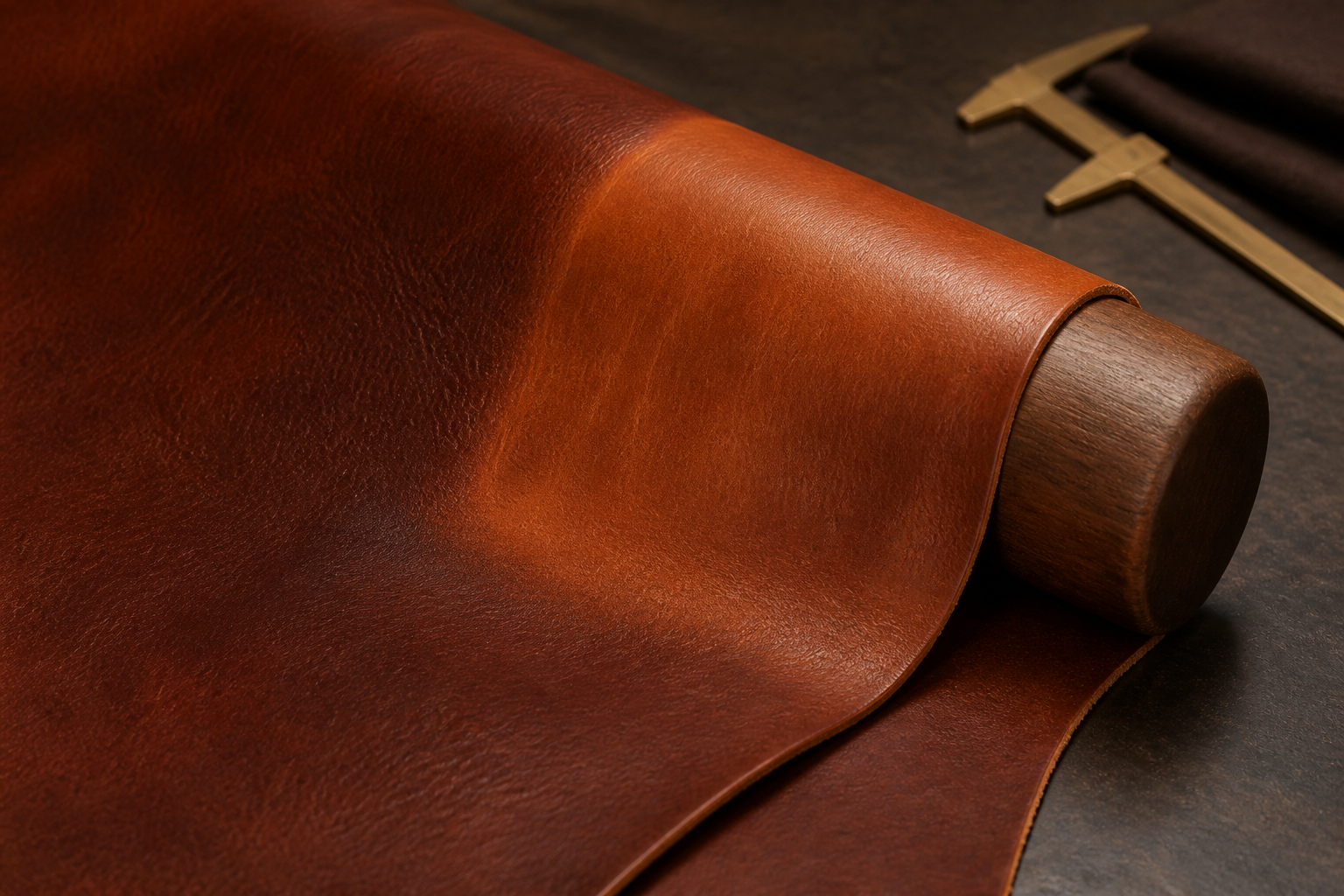
Short answer: pull-up leather is normally aniline or lightly protected leather finished with mobile oils, waxes or both. When the leather is bent, stretched or pressed, those finishing materials move within the surface and the affected area looks lighter. Rubbing or warming the leather redistributes them and can partially darken the area again.
What Does “Pull-Up” Mean?
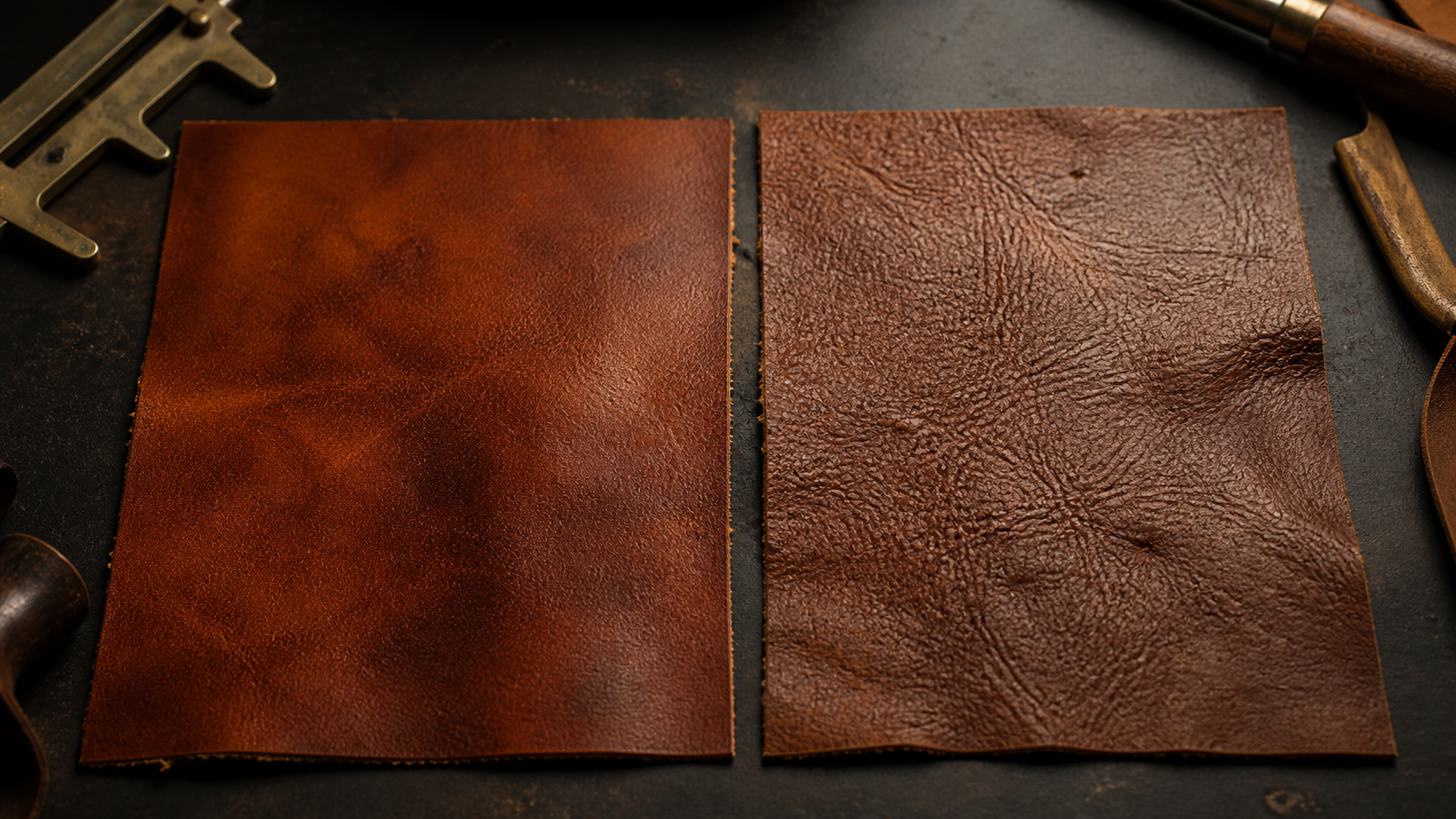
The name describes a visual response, not a species, hide layer or official quality grade. The “pull-up” is the lighter shade that appears when the leather is pulled over a curve or stretched from the reverse. It creates naturally changing highlights at elbows, pocket openings, seams, folds and other flex points.
Pull-up should not be confused with corrected leather that has a printed antique pattern, nor with cracking or finish failure. A controlled pull-up effect is smooth and reversible to a degree; damaged coating may split, flake or expose an unrelated substrate.
The Science Behind the Color Change
Transparent color appears darker where dyes, oils and waxes are concentrated. Bending stretches the fibre structure and temporarily displaces these mobile components, scattering more light and making the area appear lighter. When pressure is released, some material migrates back. Heat from the hand and firm rubbing accelerate redistribution.
The strength and recovery of the effect depend on oil and wax chemistry, application weight, leather absorbency, moisture, temperature, topcoat, thickness and how sharply the leather is flexed. A strong pull-up is not automatically better: the correct level is the one approved for the product.
How Pull-Up Leather Is Manufactured
- Hide selection: clean, strong hides are selected because transparent finishes reveal scars and grain variation rather than covering them.
- Tanning and retanning: the tannery builds the required fullness, strength, temper and dye affinity, commonly using chrome, chrome-free or vegetable-based systems.
- Drum dyeing: dyes penetrate the cross-section to establish the base color. Penetration reduces an unattractive pale core at cut edges.
- Fatliquoring: lubricating oils are introduced to soften fibres and influence handle. The finishing pull-up system is separate but must be compatible.
- Drying and mechanical softening: setting out, vacuum drying, toggling, milling or staking controls area, grain and temper.
- Oil and wax application: hot stuffing, roller coating, spraying or hand application adds mobile effect materials to or near the surface.
- Final finishing: ironing, glazing, polishing and a light protective coat tune gloss, touch, rub resistance and the speed of color recovery.
Oil Pull-Up vs Wax Pull-Up
Oil pull-up leather often feels supple and develops broad, fluid color movement. It can show rich depth and an easy broken-in character, but excessive free oil may migrate or mark adjacent materials.
Wax pull-up leather may feel drier or firmer and can produce sharper highlights, bloom or a surface that responds strongly to heat and rubbing. Many commercial recipes combine oils and waxes, so these terms should not be treated as rigid categories. Request the exact performance rather than relying on the name.
Full-Grain, Top-Grain and Pull-Up Leather
Pull-up is often made on full-grain or lightly corrected top-grain cowhide because the transparent finish showcases natural character. However, “pull-up” alone does not guarantee full grain. A supplier can create tonal movement on different substrates and constructions. Your specification should separately state species, layer, grain treatment and finish.
Pull-Up Leather vs Standard Finished Leather
| Factor | Pull-up leather | Standard finished leather |
|---|---|---|
| Color movement | Lightens visibly when bent or stretched | Usually remains comparatively uniform |
| Finish system | High oil and/or wax content with transparent or lightly protected finish | May use dyes, pigments and a more stable protective topcoat |
| Surface character | Rich tonal highs and lows that evolve with use | More consistent shade and appearance |
| Scratch response | Light marks often blend with rubbing or conditioning | Depends on coating; scratches may remain visible |
| Consistency | Natural variation is part of the aesthetic | Easier to control across panels and lots |
| Typical products | Heritage jackets, boots, bags, belts and upholstery | Broad fashion, uniform and commercial applications |
How to Identify Genuine Pull-Up Behavior
- Bend the sample smoothly around a rounded edge; the outer curve should become lighter.
- Release it and observe how much of the original shade returns.
- Rub the lighter area with a clean finger or soft cloth; controlled darkening indicates mobile oils or waxes.
- Inspect the grain. The tonal shift should follow flexing rather than appear as a fixed printed pattern.
- Check the reverse and cut edge to confirm the leather construction separately.
This quick test demonstrates appearance only. It does not replace laboratory checks for composition, rub fastness, finish adhesion or harmful substances.
Advantages
- Develops distinctive patina and personalized wear.
- Natural grain and transparent color create premium depth.
- Minor scuffs can often be blended by rubbing.
- Works especially well for heritage and vintage product stories.
- Rich tonal movement makes simple constructions visually interesting.
Limitations and Production Risks
- Shade variation: panels can differ because natural absorbency changes across a hide.
- Cutting sensitivity: pressure, folding and stacking may temporarily mark components.
- Oil or wax migration: excess material can stain lining, tissue or packaging.
- Heat sensitivity: warm storage may change gloss, feel or color distribution.
- Water spotting: lightly protected surfaces may darken or mark when wet.
- Color transfer: deep aniline shades require careful dry and wet rub testing.
- Inconsistent recovery: bulk lots may respond differently if the finish recipe or leather substance changes.
Best Product Applications
Pull-up cowhide is widely used for cafe-racer and heritage jackets, boots, work shoes, belts, duffel bags, briefcases, wallets and upholstery. Lighter-weight pull-up articles can suit fashion garments, but the leather must have enough drape and a controlled effect so flex points do not become excessively pale.
Buyer and QC Checklist
How to Specify Pull-Up Leather in a Tech Pack
State the species and origin where required, full-grain or top-grain construction, thickness tolerance, temper, base shade, pull-up shade, effect strength, gloss, touch, dye penetration, acceptable scars, panel-matching standard, colorfastness, flex performance, migration limits and care labeling. Include a sealed swatch and an approved finished sample photographed both flat and flexed.
Ask the tannery or manufacturer to retain the leather article number and finishing recipe. Approving color alone is insufficient because two leathers can look identical while flat yet react very differently after sewing and wear.
Care and Maintenance
Dust with a soft dry cloth and blot moisture promptly. Light scuffs may blend with clean finger pressure or a soft cloth. Use conditioners sparingly and test in a hidden area: oils and waxes can permanently darken the leather or reduce contrast. Avoid household detergent, direct heat and prolonged sunlight. For garments, recommend a professional cleaner experienced with aniline and pull-up leather.
Final Takeaway
Pull-up leather is valued because it changes rather than stays perfectly uniform. Its quality lies in controlled oil-and-wax movement, attractive grain, suitable protection and predictable bulk performance. Buyers should approve the leather in motion—flat, bent, rubbed and made into the final product—before placing a bulk order.