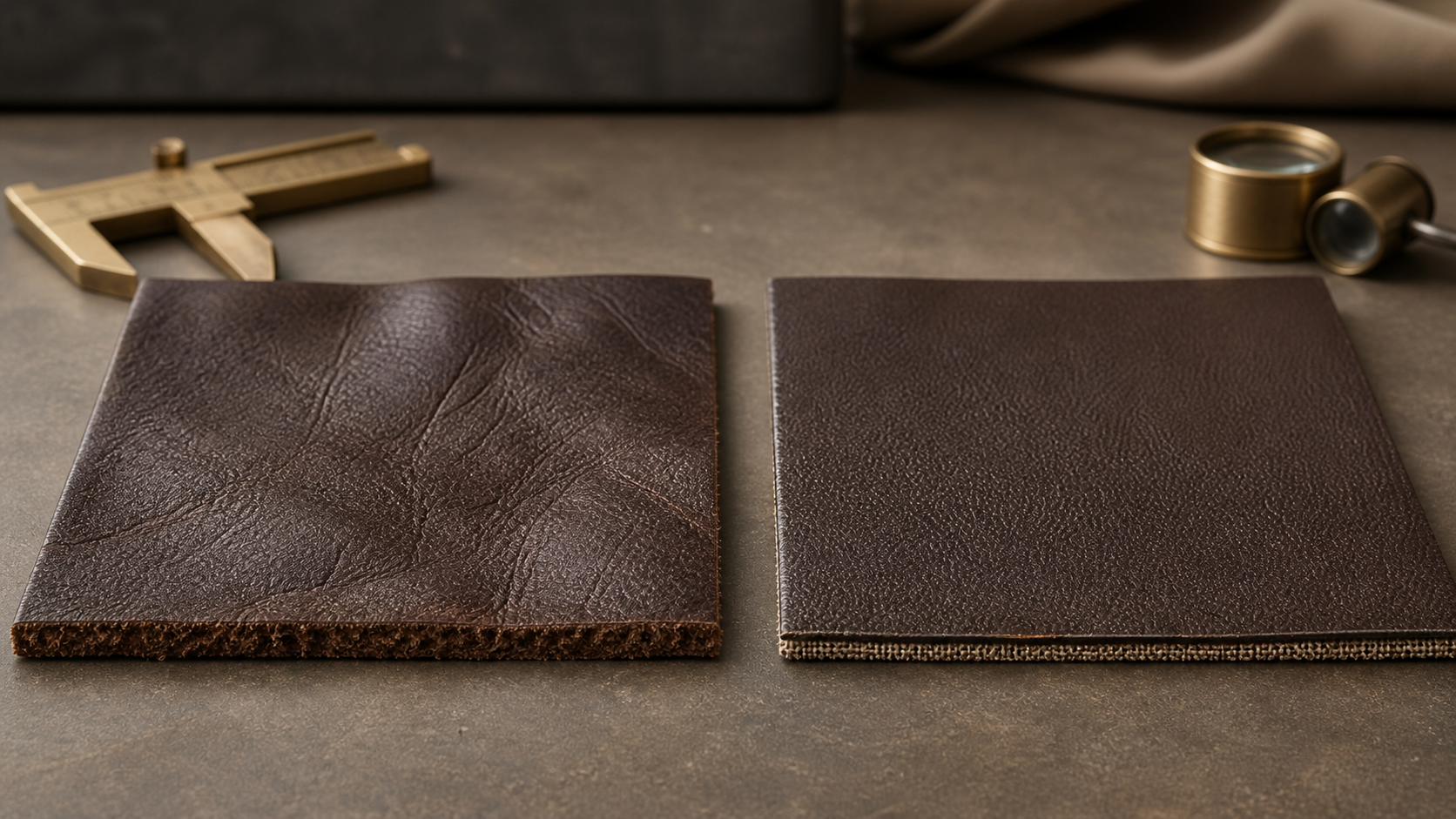
Short answer: genuine leather is made from tanned animal hide or skin and retains its natural collagen fibre structure. PU leather is normally a polyurethane-coated synthetic material carried by a textile or nonwoven backing. “Genuine leather” confirms animal-origin leather, but it is not a standardized quality grade and does not automatically mean full-grain or premium leather.
What “Genuine Leather” Actually Means
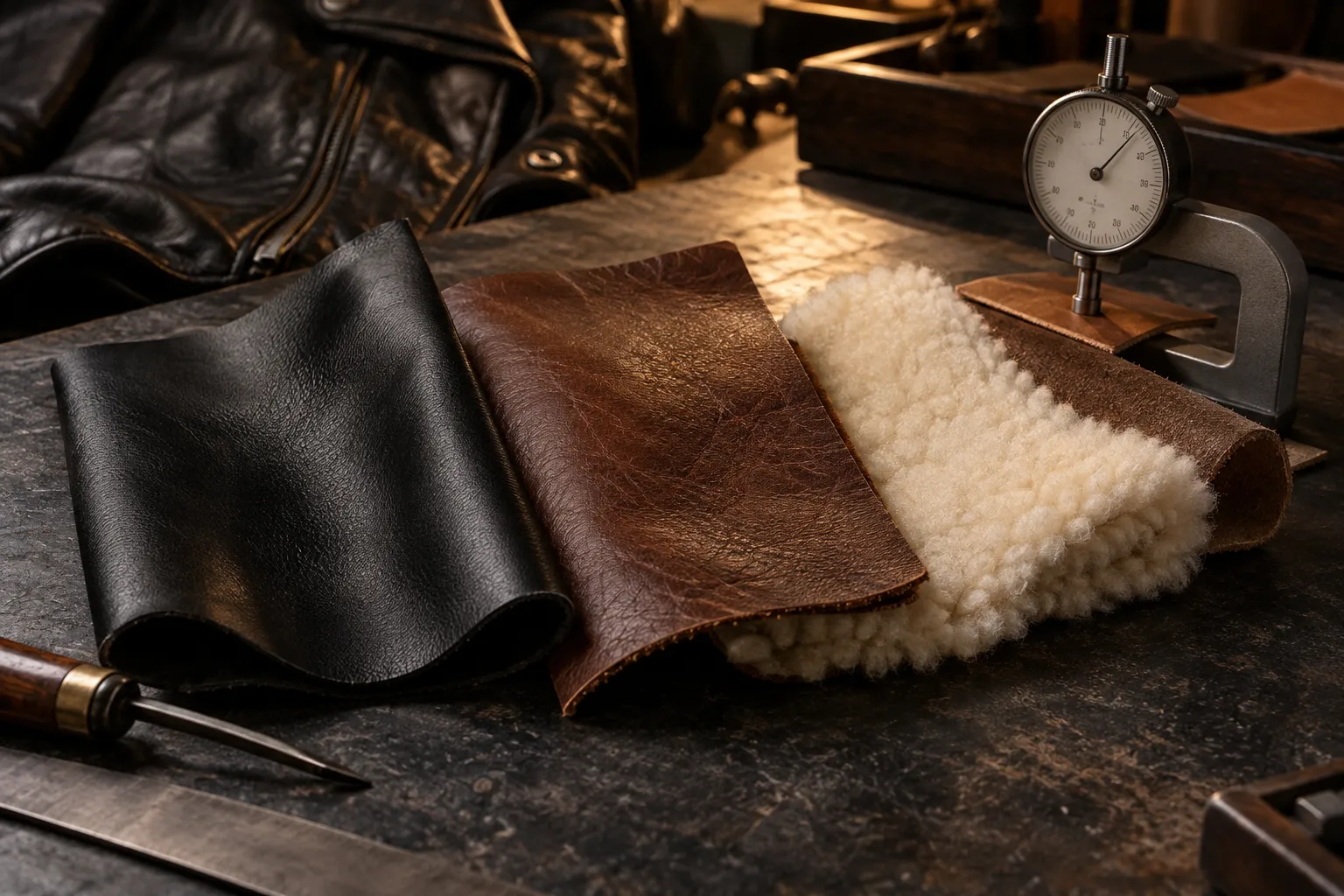
Leather Working Group terminology defines leather as animal hide or skin whose original fibrous structure remains more or less intact and has been tanned to resist decay. The material may be full grain, corrected grain, nubuck, suede, split leather, or another recognized leather construction.
Retailers often use “genuine leather” as a broad assurance that a product contains real leather. Buyers should not treat the phrase as a rank below top grain or as proof of a particular performance level. A genuine leather item can be made from excellent full-grain cowhide, soft sheep Nappa, suede split, heavily pigmented corrected grain, or a PU-coated leather split. Species, layer, finish, substance, and test results are what determine suitability.
What Is PU Leather?
PU leather is a common market name for a polyurethane-based imitation leather. A typical construction uses a woven, knitted, or nonwoven textile backing with a polyurethane foam or film surface. The surface can be colored and embossed to imitate natural grain, suede, patent, or other leather effects.
PU materials can be engineered for consistent roll width, thickness, color, stretch, gloss, flame performance, cleanability, and price. Their performance varies widely with resin chemistry, coating thickness, backing, plasticizers and additives, lamination quality, finishing, storage, humidity, heat, and expected service life.
PU Leather Is Not the Same as PU-Coated Split Leather
This distinction matters in sourcing. A fully synthetic PU material has a textile or synthetic base. A PU-coated split begins with real split leather and adds a polyurethane film or finish. Leather Working Group processing guidance describes PU split as lower split leather coated with a polyurethane film within the applicable leather terminology limits.
Always ask the supplier to declare the substrate. “PU leather,” “PU coated leather,” “coated split leather,” and “synthetic leather” should not be used interchangeably. Product labels, customs classification, footwear material declarations, and consumer claims may treat them differently.
Genuine Leather vs PU Leather
| Factor | Genuine Leather | PU Leather |
|---|---|---|
| Core material | Tanned animal hide or skin with its original fibrous structure substantially intact | A polyurethane surface layer supported by textile, nonwoven, foam, or another synthetic substrate |
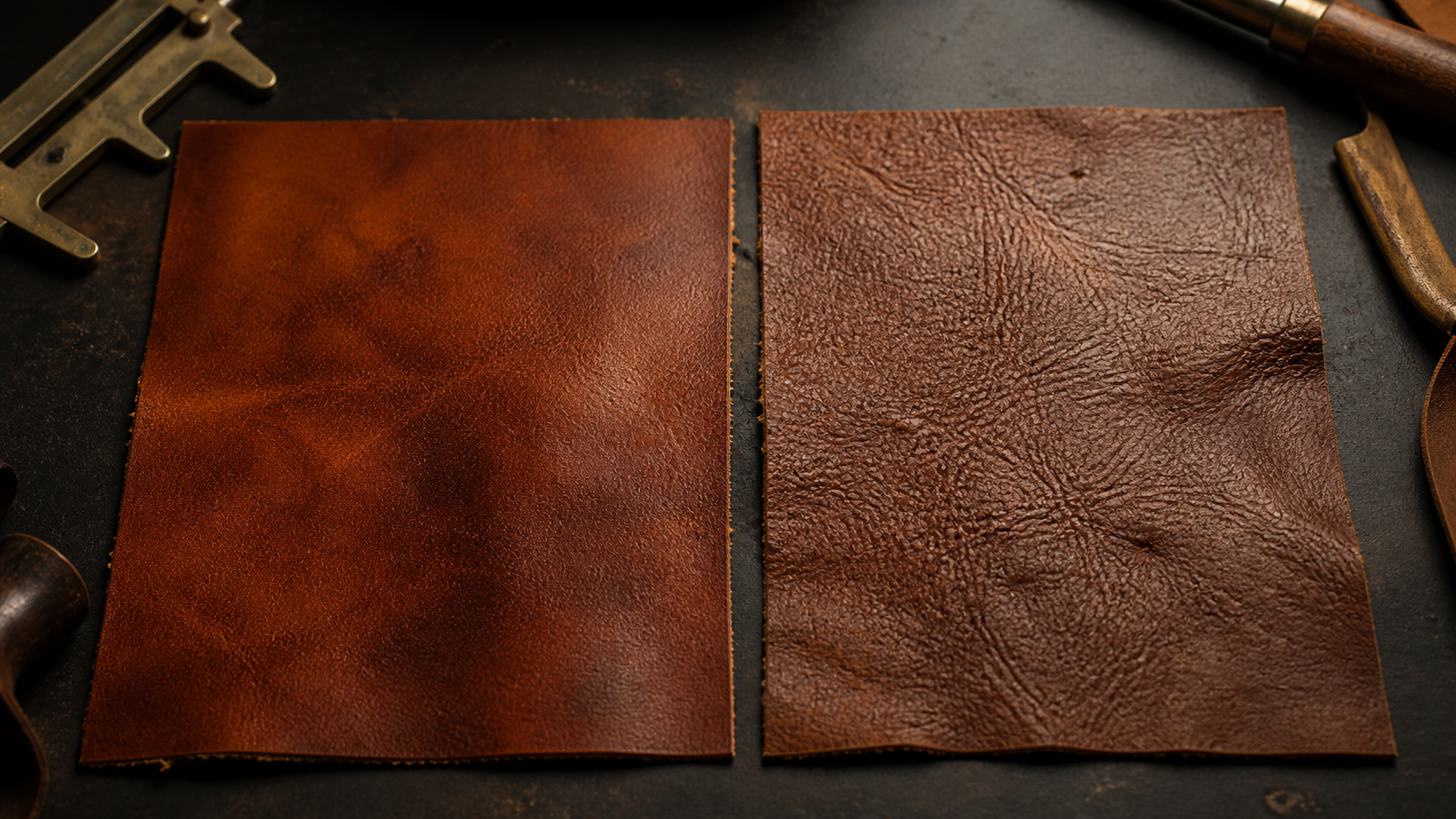
| Surface character | Natural pores and variation; may also be pigmented, corrected, embossed, or coated | Usually consistent embossed grain, color, gloss, and thickness |
| Cut edge and reverse | Fibrous leather structure continues through the section; reverse is normally flesh-like | Distinct film or foam layer over a woven, knitted, or nonwoven backing |
| Drape and break | Develops natural folds and a less repetitive break pattern | Can be engineered from soft to firm but often folds more uniformly |
| Aging | May soften, crease, burnish, and develop patina depending on finish and care | Usually keeps a controlled appearance until abrasion, hydrolysis, peeling, or cracking occurs |
| Water response | Varies by finish; unfinished and aniline surfaces absorb moisture more readily | Surface can resist initial water penetration, but seams and backing remain product-dependent |
| Consistency and yield | Natural scars, shape, and shade variation reduce cutting uniformity | Roll format supports consistent width, repeatability, and high cutting yield |
| Typical positioning | Premium and long-life jackets, footwear, bags, gloves, belts, and upholstery | Price-sensitive fashion, uniforms, promotional items, furniture, accessories, and easy-clean applications |
How to Identify the Materials
Begin with the reverse and cut edge. Natural leather usually shows an irregular, continuous fibrous section. PU synthetic normally reveals a separate surface film or foam over a woven, knitted, or nonwoven backing. Grain repetition can also help: PU embossing often repeats consistently across a roll, while natural leather contains irregular pores, wrinkles, scars, and density changes.
Touch, smell, burning, and water-drop demonstrations are unreliable as purchasing tests. Modern coatings and fragrances can imitate sensory cues, while aniline, pigmented, coated, and split leathers respond differently to water. Request a bill of materials, supplier declaration, cross-section inspection, and laboratory identification when the claim is commercially important.
Durability and Aging
Well-selected leather can flex, soften, and develop character over time. Its natural fibre network can tolerate repeated bending, but performance still depends on species, grain or split structure, thickness, tannage, finish, seam construction, exposure, and care. Poor leather may tear, stretch, lose finish, or crack.
PU leather often performs consistently in short- to medium-term controlled use. Common long-term risks include surface abrasion, edge wear, cracking, delamination, and polyurethane hydrolysis—chemical breakdown promoted by moisture, heat, storage conditions, and resin design. A low-cost PU cannot be assumed to match a premium high-performance PU, just as “genuine leather” cannot guarantee top quality.
Comfort, Breathability, and Weight
Leather can exchange some moisture and conform to the wearer, although heavy pigmentation and coatings reduce permeability. This can make suitable sheep, goat, or lightweight cow leather comfortable for jackets, gloves, footwear, and close-contact products.
PU materials can be made very light, soft, stretchable, and initially comfortable. Breathability depends on whether the coating is compact, microporous, or perforated and on the backing construction. Buyers should test water-vapor permeability, air permeability, thermal comfort, and lining behavior instead of relying on generic material claims.
Cost, Consistency, and Production Yield
Natural hides have irregular outlines and contain scars, wrinkles, shade variation, and differences between dense and loose areas. Skilled grading and nesting are required, and cutting yield changes from batch to batch. Leather also requires shade and panel matching.
PU arrives in rolls with predictable width and repeatable surface appearance. Automated cutting and high marker efficiency can reduce material waste and production time. This makes PU attractive for price-sensitive or high-volume collections, but the buyer must budget for performance testing and carefully control batch color, backing, coating, and aging.
Environmental Claims Need Evidence
Neither material should be declared universally “eco-friendly” without a defined scope and verified data. Leather uses an animal-industry by-product and can offer long service life, but tanning, water, chemicals, energy, traceability, and end-of-life performance vary by supply chain. PU avoids animal-origin leather but is a polymer material whose feedstock, solvents, additives, manufacturing emissions, durability, recyclability, and disposal also vary.
Ask for traceability, chemical compliance, restricted-substance test reports, tannery or factory environmental data, recycled-content evidence where claimed, and product-level durability information. Compare equivalent products over a realistic service period rather than judging one material from a single marketing statement.
Which Material Fits Which Product?
Choose Genuine Leather When
The brief prioritizes natural character, long-term wear, repair potential, premium hand, conformability, patina, and an authentic leather product story.
Choose PU Leather When
The brief prioritizes roll consistency, color repeatability, high cutting yield, easy cleaning, lower entry price, lightweight construction, or an animal-free material requirement.
Buyer Quality-Control Checklist
- Declare the exact material: species and leather type, PU-coated split leather, or fully synthetic PU with backing composition
- Record thickness, weight, width or hide size, color, gloss, grain, temper, stretch, and intended application
- Inspect cross-sections and reverse surfaces; keep a sealed approved swatch
- For leather, test tear, tensile strength, seam resistance, elongation, rub fastness, finish adhesion, and water spotting
- For PU, test abrasion, flexing, hydrolysis resistance, cold crack, peel strength, blocking, color migration, and backing stability
- Test finished-product seams, folds, edges, trims, adhesives, printing, and heat exposure—not only flat material
- Verify restricted substances and market-specific chemical compliance
- Run accelerated aging only with a method and acceptance criteria appropriate to the end use
- Approve production under daylight-equivalent lighting and define batch-to-batch shade tolerance
How to Write a Better Specification
A leather line could read: “Sheep Nappa leather, full grain, black semi-aniline finish, 0.7–0.9 mm, soft temper, matched visible panels, dry/wet rub and tear performance to approved standard.” Avoid writing only “100% genuine leather.”
A PU line could read: “Solvent-free polyurethane synthetic leather on polyester knitted backing, black fine pebble grain, 0.75–0.85 mm, soft temper, hydrolysis, flex, abrasion, peel strength, and restricted-substance performance to approved method.” If the base is leather split, state that explicitly instead.
The Practical Sourcing Decision
Choose genuine leather when natural fibre structure, aging, tactile depth, and long-term product value lead the brief. Choose PU when uniformity, roll efficiency, color control, easy maintenance, price, or animal-free positioning is more important. The best choice is the material that meets a transparent specification and verified end-use performance.
Hashbloom International develops private-label leather jackets, bags, gloves, trousers, skirts, and accessories. Buyers can submit a reference material, target composition, color, thickness, hand feel, quantity, labeling requirements, and performance standards for sampling and sourcing review.